
This is what I posted on Facebook: New plan. I’ve been considering pumping my solar channel by doing better videos. But that means less getting stuff done and more screwing with videos. So no. Instead I’m going to do short posts to ExpertAmateur.com, my blog, showing what I’m up to, and short, crappy videos with no editing. For all the stuff I do: Solar, motorcycles, foiling, SUP, electronics, baking (baking?), cooking, and whatever else pops into my head. First up is something a very small number of people apparently care about: A three phase solar/inverter/battery system for my shop. I just bought the inverters and batteries. Next up is the permitting process. Yeah, I know–boooring. So what. Needs to be done. Anyone with an owner-occupied building and business using 3P power should care. Power costs are going to skyrocket. No, I don’t have a crystal ball, google it, or ask your favorite flavor of AI. A 31% increase across the USA from 2020 to 2025 while demand was flat. With all the data centers coming on line it doesn’t require a crystal ball to see that power is gonna get expensive, and less reliable. Then there’s my sub 400# BMW airhead GS build (stupid, but fun), Getting my Vincent Black Shadow back on the road, the EMS system, Fire mitigation, etc. etc. My plan is to Show My Work not my results. How I do this stuff. Not that I’m such a great craftsman that anyone should care, but I do a lot of stuff, and it’s ALL amateur. If I can do it, you can do it. I’ll show you how. In little bite-sized chunks. No 30 minute videos with two days of editing. I don’t have the time for that.
So first post. Diane and I went to Manzanita for a few days mostly because her girl trip got cancelled but also because it was supposed to be blazing hot in Hood River. Nice trip. We stayed in the Coast Cabins in a kind of mega high-end “cabin” that had a hot tub, private sauna, etc. Very pleasant. We hung out, read books, and recharged. I spent a small fortune on the inverters and batteries and a few accessories I need to convert my current installation at the shop into a three phase system that will power the entire shop. I plan to stay connected to the grid, but the system will be sized and managed so it’s independant. Mostly because I can, and it’s a fun experiement. But also to make it outage proof and wildfire resilient. More on the later. My next step is meeting with contractors and the county to start the permit process and get Pacific Power on board.
Here’s the checklist and process for the project. I built this with Claude’s assistance: Hood River Solar Permitting — Process & Checklist
Project: Marblehead 3P — commercial-scale ground-mount PV + battery System: 3× EG4 18kPV, 208V three-phase wye, ~60kW PV / ~54 kW AC, DC-coupled battery + custom EMS Ponostyle LLC, Pacific Power three-phase service Updated: June 24, 2026
Working reference compiled from public Oregon / Hood River County / Pacific Power / Energy Trust sources. Not legal or code advice. Fees and rules change — confirm current numbers with each office before you rely on them. Items marked [VERIFY] are known unknowns to nail down early.
The short version
A project this size needs four parallel approvals, not one:
- Land use / zoning authorization — required for any free-standing (ground-mount) array. County Planning.
- Structural building permit — commercial, non-prescriptive path: engineered, stamped drawings + plan review.
- Electrical permit — commercial; must be pulled and performed by a licensed electrical contractor.
- Utility interconnection — Pacific Power; separate application and agreement, run alongside the permits.
The residential “prescriptive” fast-track that most solar blogs describe does not apply here — that path is for light-frame residential rooftops under code section R324. Commercial ground-mount falls under the non-prescriptive structural path, OSSC Section 3111, in the 2025 Oregon Structural Specialty Code.
Parcel & jurisdiction (confirmed)
| Field | Value |
|---|---|
| Tax lot | xxxxxxxxxx |
| Account | xxxx |
| Size | 0.94 acres |
| Class | Industrial Zoned – Improved |
| Owner | xxxxxxx |
| AHJ | Unincorporated Hood River County (outside city limits) |
Building authority — Hood River County Community Development
- 601 State Street, Hood River, OR 97031
- 541-386-1306 · building@hoodrivercounty.gov · hrccd.hoodrivercounty.gov
- The County runs building permits as a regional Hood River/Wasco codes operation; structural fees rose ~20% recently to align across the two counties.
Submittal portal: Oregon e-Permitting (buildingpermits.oregon.gov) or in person at the County office. Note Oregon e-Permitting sets up Solar/PV records incorrectly by default for a job this size — flag it as commercial structural, not residential PV. I plan to do the entire process in parson at the county
Step 0 — confirmation calls (do these first)
Knock these out before drawing anything, since they shape every form and fee below:
- Confirm the exact zone code on the parcel and what it allows for a free-standing ground-mount . [VERIFY]
- Electrical permit routing — confirm whether the County issues the electrical permit directly or whether it routes through Oregon BCD / a state electrical inspector for this jurisdiction. [VERIFY]
- Inside vs. outside the UGB — confirm the parcel sits outside the Urban Growth Boundary so you’re firmly in County (not City) administration for land use. [VERIFY]
- Whether a land-use authorization is a ministerial sign-off or a full Type I/II review for this use on industrial-zoned land — this drives the timeline more than anything else. [VERIFY]
Track 1 — Land use / zoning
- Required for any free-standing array; this is the gate before the building permit.
- Buildable footprint is the constraint: 0.94 acres with the existing shop and two 40-ft containers leaves limited ground for a ~6,000–8,000 sq ft array. A detached PV canopy over the fab yard is the recommended approach — it reclaims already-occupied ground, gives you optimal tilt/orientation, supports a DIY install, and (see Track 2) keeps you out of NEC 690.12 rapid-shutdown territory.
- Confirm setbacks, lot coverage, and height limits for the structure under the industrial zone.
Track 2 — Structural building permit (commercial, non-prescriptive)
- Path: OSSC Section 3111, 2025 Oregon Structural Specialty Code. Engineered, stamped drawings + plan review.
- You’ll need an Oregon PE stamp on the canopy/array structural package — wind and seismic loads for the site, foundation/footing design, and the connection details.I’ll be using Chiko 30 panel prefab ground mount system with Oregon engineering stamps provided by Chiko for the system
- NEC 690.12 rapid shutdown: a detached, ground-standing PV canopy (not on a building) avoids the 690.12 module-level rapid-shutdown requirement, which simplifies the design and the equipment list. This is a key reason the ground mount beats a rooftop or building-attached array here.
- Expect plan review comments; build in a revision cycle.
Track 3 — Electrical permit (commercial)
- Commercial electrical permit; generally must be pulled and performed by a licensed electrical contractor (not owner-DIY at this scale/classification). [VERIFY] the exact owner-vs-contractor rule for this commercial classification.
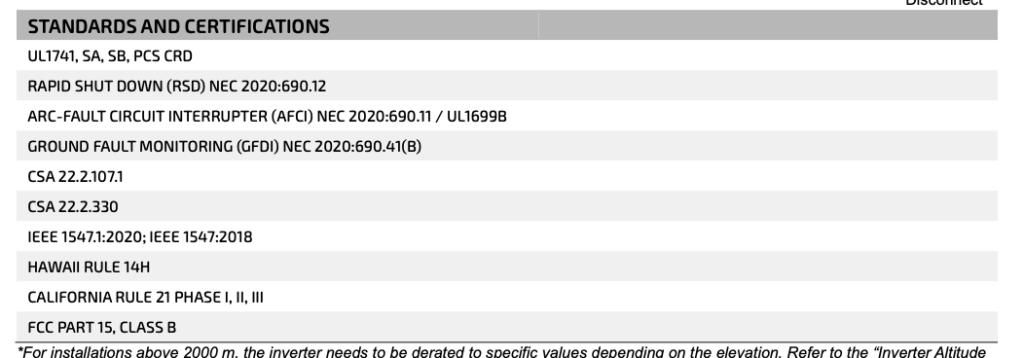
- UL 1741 SB / IEEE 1547-2018: since June 1, 2024, all new inverter-based generation must use UL 1741 SB inverters meeting IEEE 1547-2018. Verify the EG4 18kPV carries that exact listing before submittal — this is a common rejection point. (Confirmed via spec sheet)
- Three-phase 208V wye configuration and the DC-coupled battery + EMS need to be clearly drawn in the single-line.
Track 4 — Pacific Power interconnection
- Separate application and agreement; run it alongside the permits, not after.
- Schedule 135 net metering applies: commercial cap is 2 MW, full retail 1:1 credit, annual March true-up. You’re well inside the cap at ~54 kW AC.
- Decision point: net-metered interconnection (exports credited, more review) vs. non-export / self-supply (lighter interconnection path since nothing back-feeds). With the battery and a real EMS you can credibly go either way — pick based on how much you expect to export vs. self-consume.
- At 54 kW AC you’re above the 25 kW residential NEM cap but well inside the nonresidential limits.
ETO / incentive note (the tension to resolve)
- The Energy Trust of Oregon co-marketing / case-study relationship runs into the incentive program’s requirement that an approved Trade Ally contractor serve as installer of record.
- That conflicts with a DIY / owner-builder install. Decide early whether you’re chasing the ETO incentive (needs a Trade Ally) or running this as a pure owner-build case study (forgoes the incentive but keeps the DIY story intact).
- Candidate Trade Allies surfaced previously: Common Energy LLC (Hood River-local, off-grid/battery experience), National Solar, A&R Solar, Advanced Energy Systems. Authoritative current list: energytrust.org/find-a-contractor filtered by zip 97031.
- Unless EnergyTrust suddenly becomes a lot more responsive I won’t bother with this.
Suggested sequence
- Step 0 confirmation calls (above).
- Lock the Ground mount concept and get a PE engaged on the structural package. The supplied engineering documents may meet this requirement.
- File the land-use authorization (Track 1) — it gates the building permit.
- Submit structural (Track 2) and electrical (Track 3) once land use is in hand or in parallel if the County allows.
- File Pacific Power interconnection (Track 4) in parallel from the start.
- Resolve the ETO / Trade Ally decision before you commit an installer of record.
Document reuse
Much of the structural and electrical package (single-line, equipment cut sheets, UL 1741 SB listing, racking/canopy details) carries over between tracks and into the Pacific Power application. Build one clean source set and reuse it.